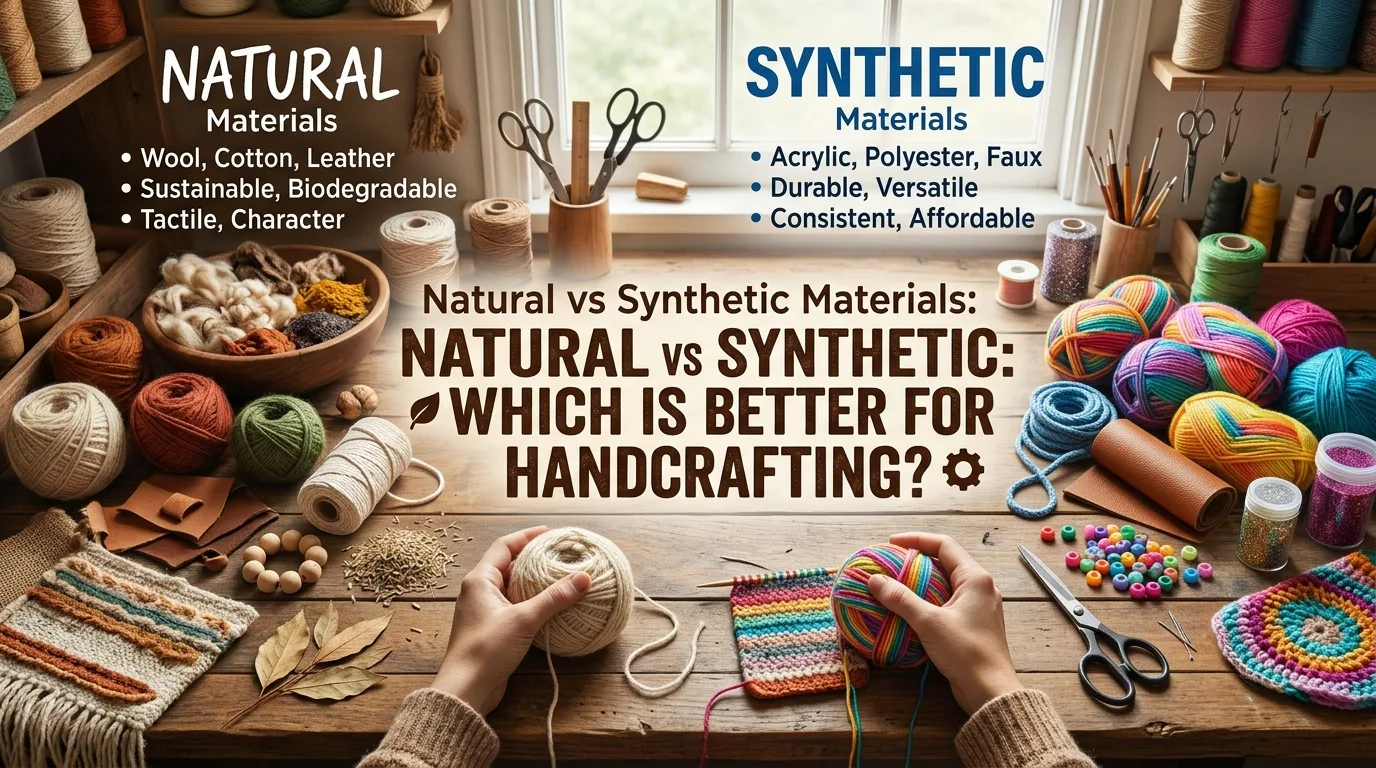
You are standing in a craft shop aisle, or more likely staring at two browser tabs, and the same question keeps surfacing: do I buy the wool, the linen, the real leather, or do I buy the acrylic yarn, the polyester felt, the faux leather? The natural option feels right. The synthetic option fits your budget and your Tuesday deadline. Both are legitimate, and the choice is usually less about morality than about matching a material to a project, a person, and a plan.
This article gives you the criteria that actually matter, honest pros and cons for each side, and a clear way to decide for your situation. It will not tell you that natural always wins or that synthetic is secretly fine. It depends on what you are making and who is going to use it.
What are you actually choosing between?
"Natural" covers anything grown, harvested, or animal-derived: cotton, linen, wool, silk, hemp, jute, leather, wood, bamboo, beeswax, clay. "Synthetic" covers anything made through industrial chemistry: acrylic, polyester, nylon, polypropylene, EVA foam, resin, faux leather, most polymer clays.
The real dilemma is that the two categories trade off against each other on four things: cost, durability, environmental footprint, and how pleasant the material is to work with. A material can win on one and lose badly on another. That is why "which is better" has no single answer.
Natural materials: the honest case for and against
Natural materials are usually the reason people get into crafting in the first place. Wool smells like wool. Linen has a weight and a slub that no synthetic reproduces. Leather ages into something better than it started.
The practical upside is real. Natural fibres tend to breathe, take dye predictably, and hold up over years if cared for. Wood and leather can be repaired and refinished rather than thrown away. For anything meant to be kept, worn, or handed down, natural materials usually earn their price.
The downsides are just as real. Cost is the big one. A skein of good wool might run two to four times the price of a comparable acrylic, and that gap widens with quality. Natural fibres also vary from batch to batch, which is charming until you need a second skein and the dye lot is gone. They can shrink, felt, warp, or crack if you store them wrong. And "natural" does not automatically mean low impact: cotton is a thirsty crop, and some natural dyes and finishes carry their own concerns. If you want to dig into how these terms are defined, the site's glossary of key terms is a good place to start.
Synthetic materials: the honest case for and against
Synthetic materials get a bad reputation, and some of it is deserved. But dismissing them outright means missing what they are genuinely good at.
They are consistent. The same acrylic yarn in the same colour will behave the same way next month, which matters enormously if you are making a set of anything. They are cheap, which makes them the sane choice for practice pieces, kids' projects, and anything that will be outgrown or worn out fast. Many are strong, machine-washable, and resistant to moths and rot.
The environmental case is where synthetics struggle. They are petroleum-derived, they shed microplastics when washed, and they do not biodegrade. A polyester felt ornament will outlast the person who made it, and not in a good way. They can also be less pleasant to handle: acrylic squeaks on the needles, some synthetics melt under a hot glue gun, and faux leather can crack at the fold. If you want to weigh the footprint side more carefully, the practical guides and articles on this site cover material sourcing in more depth.
A worked comparison: one project, two ways
Say you want to make a chunky knit throw roughly 120 cm by 150 cm. In a super-bulky yarn you might need around 8 to 10 balls.
In a mid-range wool, at an approximate £8-£15 per ball, that is roughly £70-£150. In a comparable acrylic, at roughly £3-£6 per ball, you are looking at £25-£60. These are ballpark figures and vary a lot by brand and country, so check current prices before you commit.
The wool throw will be warmer, will age gracefully, and can be repaired. The acrylic throw will be washable, cheaper, and easier to gift to a household with small children. Neither is wrong. The calculation just shows you what the trade-off actually costs, which is the whole point of running the numbers before you buy. The site's free calculators can help you scale a project budget once you know your per-unit cost.
Side-by-side: the criteria that matter
| Criterion | Natural materials | Synthetic materials |
|---|---|---|
| Typical cost | Higher, often 2-4x synthetic | Lower, predictable |
| Consistency | Varies by batch and dye lot | Highly consistent |
| Durability | Good with care, repairable | Strong, but can crack or pill |
| End of life | Often biodegradable or compostable | Persists; microplastic shedding |
| Feel and workability | Pleasant, rewards skill | Can squeak, melt, or fight back |
| Best for | Heirlooms, wearables, gifts | Practice, kids, volume, washables |
Which one should you choose?
There is no universal answer, so match the material to your situation.
If you are on a tight budget: start with synthetics for practice and high-volume projects, and save natural fibres for the pieces you actually want to keep. You will learn faster and waste less expensive yarn.
If you craft with or for children: synthetics win on washability and cost. A machine-washable acrylic that survives a preschool is a kindness to everyone. Choose natural fibres for items that will not be washed often, like a wall hanging or a soft toy.
If you craft solo and slowly: natural materials usually pay off. You are investing hours into a piece, and the material quality is what you will notice in five years.
If you are a beginner: cheap synthetic is your friend. Make your mistakes on the affordable stuff, then graduate to wool and linen once your tension is steady.
If you are advanced or selling your work: natural materials often justify their price in perceived value, and they photograph better. Just price honestly, including your time.
If sustainability is your main driver: natural is not automatically the greener choice. Look at how the fibre was grown or produced, how far it travelled, and how the finished object will be used and disposed of. The site's interactive decision trees can walk you through this if you want a structured way to weigh it.
If wood, lumber, or timber is part of your project, the woodworking tools and guides site covers that side in more depth.
FAQ
Is natural always more sustainable than synthetic? No. Cotton uses a lot of water, some natural dyes and finishes carry concerns, and transport matters. Synthetic fibres are usually the bigger problem at end of life because they do not biodegrade and shed microplastics. Judge the specific material, not the category.
Can I mix natural and synthetic in one project? Yes, and often you should. A cotton warp with an acrylic weft, or a wool body with a synthetic lining, can give you the best of both. Just test how they behave together before you commit to a large piece.
Are synthetic materials safe for kids' crafts? Generally yes for most craft uses, but check the label, avoid anything that melts under heat, and keep small parts away from very young children. If a product has a safety warning, take it seriously.
Will natural materials really last longer? Often, but only with proper care. Wool needs washing carefully, leather needs conditioning, wood needs finishing. A neglected natural piece can fail faster than a cheap synthetic one.
How do I budget for a natural materials project? Work out your per-unit cost first, then multiply by the quantity you need, and add a margin for mistakes. The site's step-by-step wizards can help you plan a project from the material list up.
The takeaway
Natural and synthetic materials are tools, not moral positions. Natural wins on feel, repairability, and the pleasure of working with something that came from a plant or an animal. Synthetic wins on cost, consistency, and washability. The right choice depends on who the object is for, how long it needs to last, and what you can afford to spend.
If you are unsure, the site's comparison tool and recommendation tool can help you weigh the options for your specific project. And if you are still stuck, the site search will point you to the guide that fits.